
Table of Contents
What Is Digital Marketing?
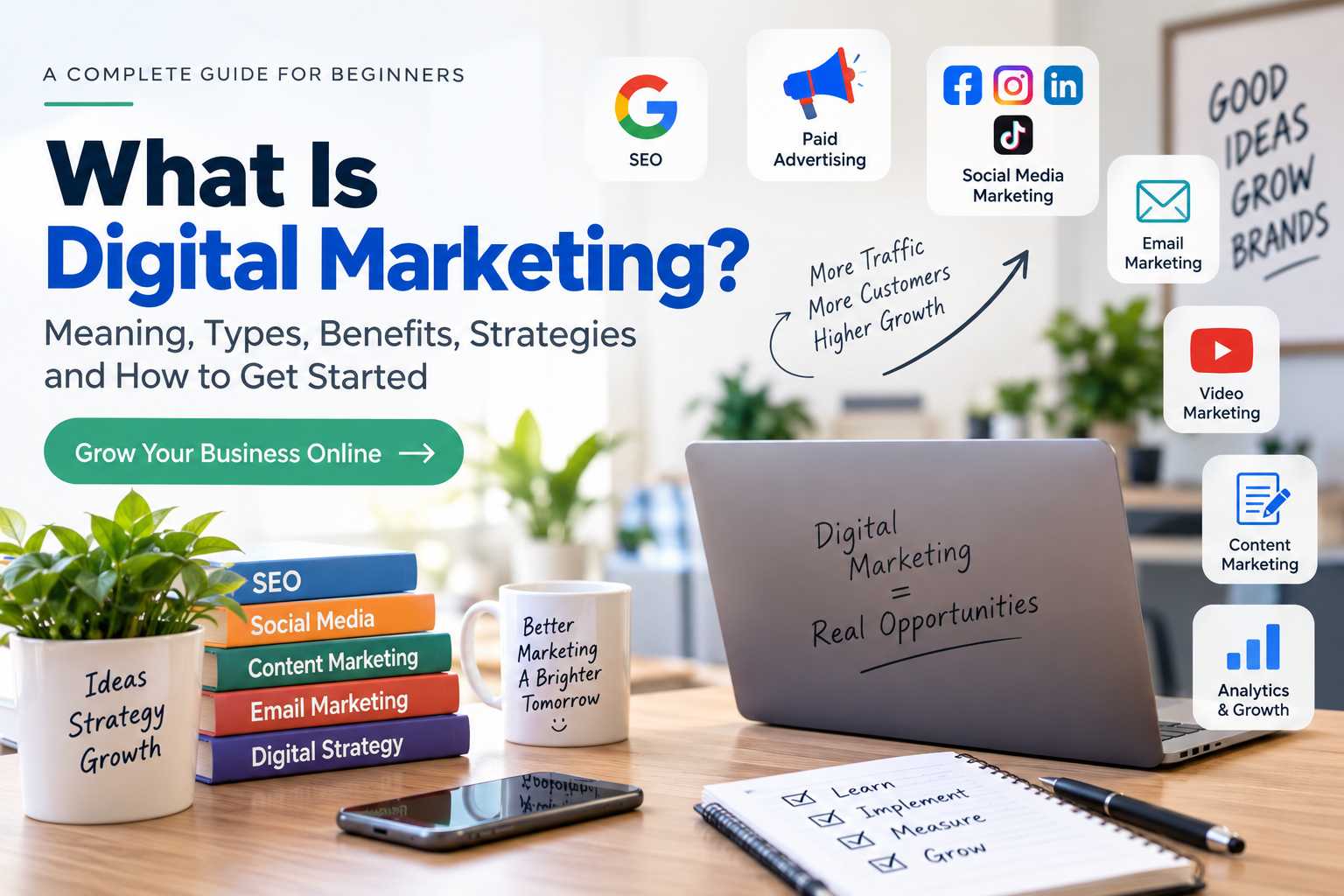
Digital marketing is the process of promoting a product, service, brand, or business through digital channels and internet-based technologies to reach and engage potential customers.
In simple terms, digital marketing means using online platforms to connect a business with its target audience.
For example, when a business:
- Appears on Google search results
- Publishes content on Facebook or Instagram
- Runs Google Ads
- Creates YouTube videos
- Sends promotional emails
- Publishes helpful blog posts
- Promotes products through online advertising
—all of these activities can be part of digital marketing.
Unlike traditional marketing, which relies heavily on channels such as television, newspapers, radio, billboards, and printed materials, digital marketing takes place primarily through websites, search engines, social media, email, mobile devices, and other digital platforms.
However, digital marketing is not simply about posting content or running advertisements. It is a broader process that involves understanding an audience, creating the right message, choosing appropriate channels, generating traffic, converting visitors into customers, and measuring results.
Digital Marketing Meaning and Definition

The digital marketing meaning is easier to understand when the term is divided into two parts.
“Digital” refers to digital technologies and online platforms, while “marketing” refers to the process of communicating value to potential customers and encouraging actions such as engagement, leads, or purchases.
Therefore, digital marketing can be defined as the use of digital channels and technologies to promote products, services, brands, or businesses and achieve specific marketing objectives.
These objectives can include:
- Building brand awareness
- Increasing website traffic
- Generating leads
- Getting more customers
- Increasing online sales
- Improving customer engagement
- Retaining existing customers
The exact objective depends on the business and its marketing strategy.
How Does Digital Marketing Work?
Understanding how digital marketing works starts with understanding the customer journey.
People usually do not see a brand for the first time and immediately make a purchase. They may first discover the brand, research the product, compare alternatives, read reviews, and then decide whether to buy.
A simple customer journey can look like this:
Awareness → Interest → Consideration → Conversion → Retention
For example, imagine that someone wants to buy running shoes.
They might first search Google for “best running shoes for beginners.” They discover an article from a sports store and learn about different types of shoes.
Later, they see the same brand on Instagram. They visit the website, look at several products, read reviews, and compare prices.
Eventually, they return to the website and purchase a pair of shoes.
In this example, several digital marketing channels worked together:
- SEO helped the customer discover the website.
- Content marketing provided useful information.
- Social media increased brand exposure.
- The website provided product information.
- Reviews helped build confidence.
- Conversion optimization helped turn the visitor into a customer.
This is how digital marketing works as a complete system rather than as a single activity.
Why Is Digital Marketing Important?

The importance of digital marketing has grown significantly because customers increasingly use digital platforms to discover information, products, services, and brands.
For businesses, being visible online can create opportunities to reach potential customers at different stages of their buying journey.
Here are some of the main reasons digital marketing is important.
1. Customers Are Online
People use search engines, social media, video platforms, websites, apps, and email every day.
If your potential customers are spending time on digital platforms, your business needs an appropriate digital presence to reach them.
2. It Helps Businesses Reach a Targeted Audience
Digital platforms can provide sophisticated audience targeting options.
Depending on the platform and campaign, businesses may be able to reach people based on factors such as location, interests, demographics, search behavior, or previous interactions.
This allows marketers to create campaigns for specific groups instead of communicating with everyone in the same way.
3. Results Can Be Measured
One of the major advantages of digital marketing is the availability of measurable data.
Depending on the channel, marketers can analyze metrics such as:
- Impressions
- Clicks
- Website visits
- Engagement
- Leads
- Conversions
- Sales
- Conversion rate
- Cost per acquisition
This data helps businesses understand what is working and where improvements may be necessary.
4. Businesses Can Start With Different Budgets
Digital marketing does not always require a large advertising budget.
A business can build organic traffic through SEO and content, grow an audience through social media, or use paid advertising with a controlled budget.
The appropriate approach depends on the business model, target audience, goals, and available resources.
5. It Supports Long-Term Brand Growth
Digital marketing is not only about immediate sales.
Consistent content, useful information, social media engagement, search visibility, and customer communication can help a business establish a stronger online presence over time.
Benefits of Digital Marketing
The benefits of digital marketing can vary depending on how it is implemented, but businesses commonly use it to achieve several important goals.
Wider Reach
A business can potentially reach customers beyond its immediate geographic area through digital channels.
Better Audience Targeting
Digital advertising and other online channels can help businesses focus their marketing efforts on relevant audiences.
Measurable Performance
Digital campaigns can be tracked using analytics and platform data, allowing marketers to evaluate performance.
Direct Customer Communication
Social media, email, messaging platforms, and other channels allow businesses to communicate directly with customers.
Increased Brand Visibility
Consistent online activity can help more people discover and recognize a brand.
Lead Generation
Websites, landing pages, forms, social media, and advertising campaigns can be used to generate leads.
Sales Opportunities
E-commerce websites and conversion-focused campaigns can connect marketing activities directly to online purchases.
Continuous Optimization
Because digital campaigns generate data, marketers can test different messages, audiences, creatives, and landing pages and make adjustments based on performance.
Types of Digital Marketing
There are many types of digital marketing, and each serves a different purpose. Businesses do not necessarily need to use every channel. The right combination depends on the target audience and business objectives.
1. Search Engine Optimization (SEO)
Search Engine Optimization, commonly known as SEO, is the process of improving a website and its content to increase visibility in organic search results.
For example, if someone searches for “how to start a small business,” a website that has useful, relevant, and well-optimized content may have an opportunity to appear in search results.
SEO can involve:
- Keyword research
- Content optimization
- Technical SEO
- On-page SEO
- Internal linking
- Website performance
- Backlink development
- Search intent optimization
Unlike paid advertising, organic search traffic does not require paying for every individual click, although SEO itself requires time, expertise, and ongoing work.
2. Social Media Marketing
Social media marketing involves using platforms such as Facebook, Instagram, LinkedIn, TikTok, and other social networks to build awareness, engage audiences, distribute content, and promote products or services.
Businesses can use both organic content and paid advertising.
For example, a brand might publish educational videos organically while using paid campaigns to promote a specific product to a relevant audience.
3. Content Marketing
Content marketing focuses on creating and distributing useful, relevant, and valuable content for a specific audience.
Common content formats include:
- Blog articles
- Videos
- Guides
- Ebooks
- Infographics
- Podcasts
- Social media posts
- Tutorials
Instead of focusing only on direct promotion, content marketing can help answer customer questions, solve problems, demonstrate expertise, and support the buying journey.
4. Search Engine Marketing and PPC
Paid search advertising allows businesses to display advertisements when people search for relevant keywords.
Pay-per-click, or PPC, advertising is a common digital advertising model in which advertisers may pay when someone clicks an advertisement.
Businesses can use paid search to promote products, services, landing pages, or other offers.
5. Email Marketing
Email marketing allows businesses to communicate directly with subscribers and existing customers.
Businesses may use email for:
- Newsletters
- Product announcements
- Promotional offers
- Educational content
- Customer onboarding
- Automated follow-ups
- Abandoned-cart reminders
A well-managed email strategy can help businesses maintain relationships with their audience beyond a single website visit.
6. Affiliate Marketing
Affiliate marketing is a performance-based model where individuals or organizations promote another company’s products or services and receive a commission when a qualifying action occurs.
For example, a content creator may recommend a product through a tracked affiliate link. If a customer makes a qualifying purchase through that link, the creator may receive a commission.
7. Video Marketing
Video marketing uses video content to educate, entertain, demonstrate, or promote.
Platforms such as YouTube, Instagram, TikTok, and Facebook provide businesses with opportunities to use both short-form and long-form video.
Product demonstrations, tutorials, reviews, educational videos, testimonials, and behind-the-scenes content are common examples.
Digital Marketing Channels
A digital marketing channel is a platform or method through which a business communicates with its audience.
Common digital marketing channels include:
- Search engines
- Business websites
- Blogs
- YouTube
- TikTok
- Search advertising
- Display advertising
- Online marketplaces
The best channel is not necessarily the one with the largest audience. It is the channel where your target customers are active and where your business can realistically achieve its objectives.
For example, a B2B software company may focus heavily on search, LinkedIn, educational content, and email, while a fashion brand may rely more heavily on Instagram, TikTok, creators, and visual content.
What Is a Digital Marketing Strategy?
A digital marketing strategy is a structured plan that explains how a business will use digital channels and marketing activities to achieve specific goals.
A basic strategy can include the following steps:
Step 1: Define Your Goal
Start by deciding what you want to achieve.
Your objective could be:
- More website traffic
- More leads
- More sales
- Greater brand awareness
- More app downloads
- Better customer retention
A clear objective makes it easier to select the right channels and measure performance.
Step 2: Understand Your Target Audience
Identify who you want to reach.
Consider their:
- Needs
- Problems
- Interests
- Buying behavior
- Online habits
- Preferred platforms
The better you understand your audience, the easier it becomes to create relevant marketing messages.
Step 3: Research Your Competitors
Study what similar businesses are doing online.
Look at their content, websites, search visibility, social media presence, advertising messages, offers, and customer experience.
Competitor research can help you identify opportunities and gaps.
Step 4: Choose the Right Channels
Do not automatically try to use every platform.
Choose channels based on where your audience is and what you want to achieve.
Step 5: Create Useful Content
Create content that addresses the questions and problems your audience actually has.
The content should be relevant to their stage of the customer journey.
Step 6: Measure the Results
Track meaningful metrics rather than focusing only on likes or views.
For a lead-generation campaign, leads and cost per lead may be more important than total impressions.
For an e-commerce campaign, purchases, revenue, conversion rate, and acquisition cost may matter more.
Step 7: Optimize
Digital marketing is an ongoing process.
Use performance data to identify what is working, test new approaches, and improve your campaigns over time.
Digital Marketing Examples
Consider a local restaurant launching a new menu.
The restaurant could create short videos showcasing the new dishes, publish them on social media, update its online business information, run location-based advertisements, and send an offer to existing customers through email.
Now consider an online clothing store.
It could publish SEO-focused articles, optimize product pages, create social media videos, run paid advertising, collect customer reviews, and use email automation to follow up with customers.
These are different businesses with different audiences, but both can use multiple digital channels as part of an overall marketing strategy.
Digital Marketing for Beginners: How to Get Started
If you are completely new to digital marketing, do not try to master every channel at once.
Start by learning the fundamentals of marketing and customer behavior. Then choose one or two areas that match your interests or career goals.
A practical learning path could look like this:
Marketing Fundamentals → SEO → Content → Social Media → Paid Advertising → Analytics → Conversion Optimization
You do not need to follow this exact order, but learning the fundamentals first will make the advanced topics easier to understand.
Most importantly, practice while learning.
Create a small website, start a social media page, publish content, conduct keyword research, build a simple campaign, or analyze an existing business.
Practical experience helps you understand how different concepts work together.
You should also learn basic analytics and conversion tracking. A digital marketer needs to understand not only how to attract visitors but also what those visitors do after reaching a website or landing page.
Digital Marketing vs Traditional Marketing
Traditional marketing and digital marketing both aim to communicate with potential customers, but they use different channels and methods.
Traditional marketing commonly includes television, radio, newspapers, magazines, billboards, and printed materials.
Digital marketing uses websites, search engines, social media, email, digital advertising, video platforms, and other online channels.
Digital channels can offer detailed performance data and flexible targeting options. However, the right marketing approach depends on the business, audience, product, budget, and objective.
In some cases, businesses can also combine traditional and digital methods rather than choosing only one.
Final Thoughts
Digital marketing is much more than social media posts or online advertisements. It is a complete approach to reaching people through digital channels, understanding their needs, providing relevant information, building relationships, and guiding them toward valuable actions.
Understanding the basics is the first step.
Once you understand what digital marketing is, how it works, why it is important, and how its different channels fit together, you can begin developing specific skills in SEO, social media marketing, content marketing, email marketing, paid advertising, analytics, and conversion optimization.
The most effective way to learn is to combine knowledge with practical experience. Start with a small project, test what you learn, measure the results, and improve your approach based on real data.
That process will help you move from simply understanding digital marketing to actually using it to create measurable results.